.svg)
.svg)
.svg)
.svg)

Anxiety & Addiction Treatment
Individualized, evidence-based care in a private Hollywood Hills setting. Same clinical team from intake through aftercare.

The Connection Between Anxiety and Addiction
Anxiety disorders and substance use disorders are among the most commonly co-occurring conditions in clinical practice. Each condition tends to worsen the other — substances are frequently used to manage anxiety symptoms, while sustained substance use worsens the underlying condition and makes recovery harder. Anxiety also commonly co-occurs with depression and PTSD — overlapping conditions that share many triggers and often require coordinated treatment.
Treating only the addiction without addressing anxiety leaves the most powerful driver of substance use unaddressed. This is why integrated dual diagnosis treatment — treating both conditions simultaneously within a unified clinical plan — produces significantly better outcomes than treating either in isolation.
What Does Research Say About Anxiety & Addiction
Anxiety disorders are the most common mental health conditions in the United States. According to the National Institute of Mental Health (NIMH), approximately 31 percent of U.S. adults will experience an anxiety disorder at some point in their lives, with about 19 million Americans meeting diagnostic criteria in any given year. The Anxiety and Depression Association of America (ADAA) estimates that anxiety disorders affect 40 million adults annually — a prevalence that makes them one of the most frequently co-occurring conditions alongside substance use disorders.
Research published by the Substance Abuse and Mental Health Services Administration (SAMHSA) and the National Institute on Drug Abuse (NIDA) shows that individuals with anxiety disorders are roughly twice as likely to develop a substance use disorder as the general population — and the reverse is equally true. Studies from Harvard Medical School and the National Comorbidity Survey Replication have documented that anxiety and substance use disorders share overlapping neurobiological pathways involving the amygdala, prefrontal cortex, and the brain's stress-response systems, making the two conditions deeply intertwined at a physiological level.
The self-medication hypothesis — extensively studied by Dr. Edward Khantzian at Harvard Medical School — offers a well-supported clinical framework: people with undiagnosed or undertreated anxiety frequently turn to alcohol, benzodiazepines, cannabis, and opioids to blunt anxious arousal. Over time, the substance use itself dysregulates the very anxiety systems it was meant to calm, driving both conditions deeper. Clinical trials from the National Institutes of Health (NIH) demonstrate that integrated dual-diagnosis treatment — addressing anxiety and addiction simultaneously within the same clinical plan — produces significantly better outcomes than sequential or siloed approaches.
Symptoms and Presentation
Physical Symptoms
Racing heart, sweating, trembling, muscle tension, and sleep disturbances that intensify during withdrawal.
Psychological Symptoms
Excessive worry, restlessness, difficulty concentrating, and irritability that often precede substance use.
Behavioral Patterns
Avoidance, isolation, and compulsive substance use as self-medication — creating a cycle that deepens both conditions.
Anxiety spikes sharply during withdrawal from alcohol and benzodiazepines. Distinguishing withdrawal-driven anxiety from underlying anxiety disorder requires clinical assessment after stabilization.
Start your recovery
Our admissions team is available around the clock — confidentially, and without pressure.
How We Treat Anxiety and Addiction
Gradual Exposure Therapy
Systematic desensitization that reduces anxiety triggers without relying on substances, building confidence in managing discomfort.
Non-Benzodiazepine Medication
SSRIs, SNRIs, and buspirone that treat anxiety without the dependence risk of benzodiazepines.
Somatic Regulation
Body-based techniques that calm the nervous system directly — breathwork, progressive relaxation, and mindfulness practices.
"Anxiety and addiction feed each other. Break the cycle by treating both at once — not one after the other."
Addictions We Treat Alongside This
Four Pillars of Anxiety and Addiction Care

Clinical Assessment & Stabilization
A thorough evaluation distinguishes primary anxiety disorder from withdrawal-driven anxiety — a critical distinction that shapes the entire treatment plan. Medical stabilization addresses the physical symptoms that spike during early recovery.
Evidence-Based Therapy
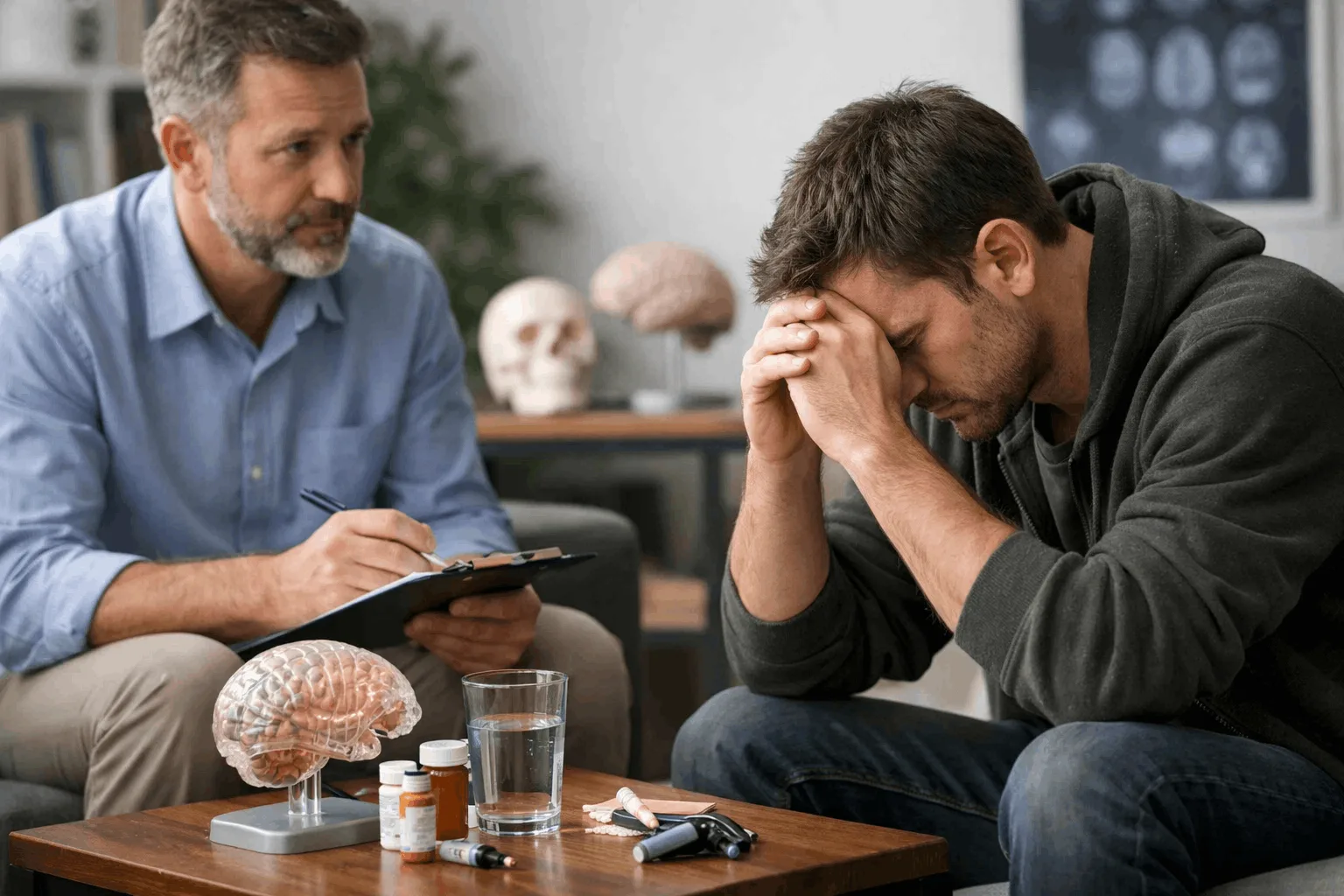
CBT, gradual exposure, and somatic regulation techniques build non-pharmaceutical tools for managing anxiety. Individual and group sessions run in parallel, giving clients multiple pathways to practice new coping strategies.

Integrated Dual Diagnosis Care
Anxiety and addiction feed each other. SSRIs, SNRIs, and buspirone treat anxiety without the dependence risk of benzodiazepines — all coordinated with recovery goals within a single unified clinical plan.

Aftercare and Long-Term Support
Recovery extends beyond discharge. Our step-down PHP/IOP programming and alumni community keep clients connected, accountable, and supported during the months and years that follow residential treatment.

Start Your Recovery from Anxiety and Addiction Today
You don't have to face anxiety and addiction alone. Our team of compassionate clinicians is available around the clock — confidentially, and without pressure — to guide you toward lasting recovery.
FAQ about Anxiety and Addiction
Is it normal to feel more anxious after stopping alcohol?
Yes. Anxiety is one of the primary symptoms of alcohol withdrawal. This is a neurological phenomenon — not a sign that sobriety makes anxiety worse permanently.
Can anxiety disorders be treated without benzodiazepines?
Yes — and this is standard clinical practice. SSRIs, SNRIs, buspirone, and beta-blockers are all effective without the dependence risk.
Does insurance cover anxiety and addiction treatment at Bliss Recovery?
Yes. We're in-network with HealthSmart, MultiPlan, PMCS, and TriWest, and most major commercial PPO plans cover integrated dual-diagnosis treatment for anxiety disorders and co-occurring substance use disorder under the Mental Health Parity and Addiction Equity Act. Coverage depends on your specific plan and level of care. Our admissions team verifies your benefits in detail before you commit to anything.
What types of anxiety disorders do you treat alongside addiction?
We treat the full spectrum of anxiety disorders co-occurring with substance use disorder: Generalized Anxiety Disorder (GAD), Panic Disorder, Social Anxiety Disorder, specific phobias, and Agoraphobia. OCD and PTSD — which have significant anxiety components — are also treated as separate dual-diagnosis presentations.
How long does dual diagnosis treatment for anxiety and addiction take?
Most clients begin with medically supervised detox (5 to 10 days), followed by residential treatment of an individualized length. PHP and IOP step-down programming typically add another 4 to 12 weeks. Evidence-based therapies like CBT require consistent practice over time — adequate treatment length significantly improves long-term outcomes compared to abbreviated programs.
What does anxiety and addiction treatment look like at Bliss Recovery?
Treatment begins with a comprehensive psychiatric assessment covering the anxiety disorder, substance use history, and any other co-occurring conditions. Our clinical team builds a unified treatment plan addressing both simultaneously. CBT — including exposure-based techniques for anxiety — is the primary evidence-based approach, supported by medication management (non-habit-forming options where appropriate) and holistic modalities that build long-term nervous system regulation.
Is residential treatment the right level of care for anxiety and addiction?
For clients in the self-medication cycle — where anxiety drives substance use and substance use amplifies anxiety over time — residential treatment breaks the cycle by providing a stable, structured environment with consistent clinical support. Removing the substance while simultaneously building anxiety management skills through evidence-based therapy produces better outcomes than addressing either condition in isolation. PHP and IOP are appropriate next steps after residential stabilization.
Related Conditions & Programs
Mental health and addiction treated together.
Co-occurring disorders reinforce each other. We treat both simultaneously — with psychiatric support, therapy, and medication management.