.svg)
.svg)
.svg)
.svg)

Schizophrenia & Addiction Treatment
Individualized, evidence-based care in a private Hollywood Hills setting. Same clinical team from intake through aftercare.
The Schizophrenia Connection
Schizophrenia and substance use disorders are among the most commonly co-occurring conditions in clinical practice. Each condition tends to worsen the other — substances are frequently used to manage schizophrenia symptoms, while sustained substance use worsens the underlying condition and makes recovery harder.

Schizophrenia and Addiction Together
Schizophrenia and substance use disorders are among the most commonly co-occurring conditions in clinical practice. Each condition tends to worsen the other — substances are frequently used to manage schizophrenia symptoms, while sustained substance use worsens the underlying condition and makes recovery harder. Schizophrenia also frequently co-occurs with depression and anxiety disorders — conditions whose symptoms can overlap with negative and positive psychotic symptoms, making integrated assessment essential.
Treating only the addiction without addressing schizophrenia leaves the most powerful driver of substance use unaddressed. This is why integrated dual diagnosis treatment — treating both conditions simultaneously within a unified clinical plan — produces significantly better outcomes than treating either in isolation.
Symptoms and Presentation
Schizophrenia presents alongside addiction in ways that can make diagnosis and treatment more complex. Substance use can mimic, mask, or worsen schizophrenia symptoms. A comprehensive clinical assessment — conducted after a sufficient period of stabilization — is essential for accurate diagnosis and appropriate treatment planning.
Substances can produce psychotic symptoms that look identical to schizophrenia. Distinguishing substance-induced psychosis from primary psychotic disorder requires careful assessment after sobriety.
Start your recovery
Our admissions team is available around the clock — confidentially, and without pressure.
How We Treat Schizophrenia and Addiction
Antipsychotic Management
Long-acting injectable medications and carefully monitored oral regimens that stabilize psychosis while supporting recovery engagement.
Cognitive Remediation
Targeted exercises that improve attention, memory, and executive function — addressing the cognitive deficits that make recovery harder.
Family Integration
Psychoeducation and structured communication training for families, reducing relapse risk through strengthened support systems.
"Clarity of mind and clarity of sobriety are intertwined. Treat both, and recovery becomes possible."
Addictions We Treat Alongside This
Four Pillars of Schizophrenia and Addiction Care

Antipsychotic Management
Long-acting injectable medications and carefully monitored oral regimens stabilize psychosis while supporting engagement in recovery. Our psychiatric team distinguishes substance-induced psychosis from primary psychotic disorder to guide appropriate medication choices.
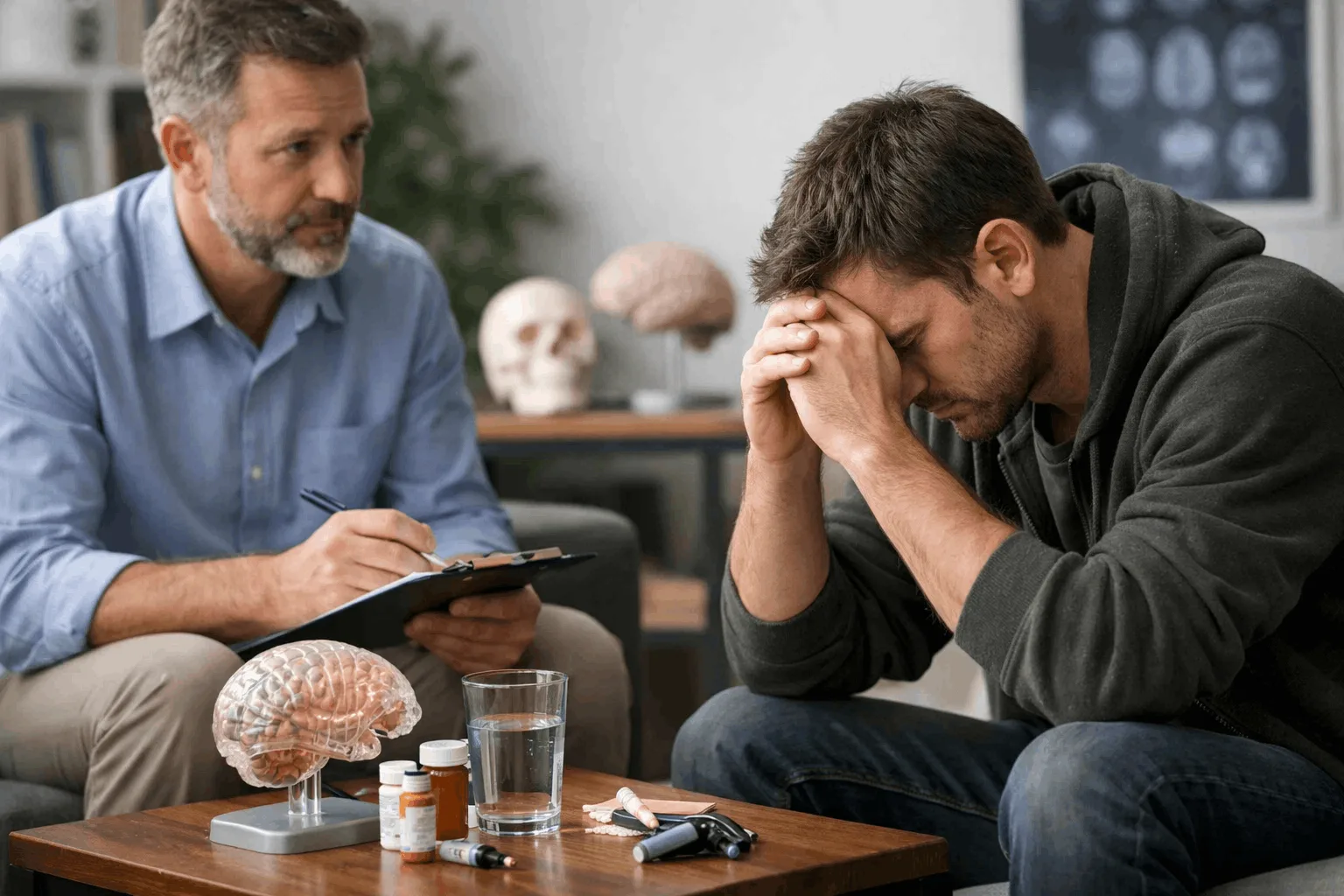
Cognitive Remediation Therapy
Targeted exercises improve attention, memory, and executive function — addressing the cognitive deficits that make recovery harder. Individual and group therapy sessions are adapted to meet clients where they are cognitively.

Integrated Dual Diagnosis Care
Clarity of mind and clarity of sobriety are intertwined. Our unified clinical plan treats schizophrenia and substance use disorder simultaneously, because neither condition can be fully addressed without treating the other.

Family Integration & Aftercare
Psychoeducation and structured communication training for families reduces relapse risk through strengthened support systems. Our step-down PHP/IOP programming sustains the gains made during residential treatment.

Start Your Recovery from Schizophrenia and Addiction Today
You don't have to face schizophrenia and addiction alone. Our team of compassionate clinicians is available around the clock — confidentially, and without pressure — to guide you toward lasting recovery.
FAQ about Schizophrenia and Addiction
How long does it take to know whether psychosis is schizophrenia or substance-induced?
A period of 4–8 weeks of sobriety is the clinical standard. Some substance-induced psychosis clears within days; some persists for months.
Does schizophrenia require ongoing medication after treatment?
Yes, for most people. Antipsychotic medication is typically long-term. Discontinuing medication is the primary risk factor for psychotic relapse.
Why do people with schizophrenia have higher rates of substance use?
People with schizophrenia are significantly more likely to develop substance use disorders than the general population. Several factors drive this: self-medication of psychotic symptoms (particularly negative symptoms like flat affect and amotivation) with cannabis, alcohol, or stimulants; social marginalization; and the neurobiological overlap between psychosis-related dopamine dysregulation and the brain's reward circuitry. Cannabis and stimulants can precipitate or worsen psychotic episodes, creating a dangerous cycle.
Does insurance cover schizophrenia and addiction treatment at Bliss Recovery?
Yes. We're in-network with HealthSmart, MultiPlan, PMCS, and TriWest, and most major commercial PPO plans cover integrated dual-diagnosis treatment for schizophrenia and co-occurring substance use disorder under the Mental Health Parity and Addiction Equity Act. Coverage depends on your specific plan and level of care. Our admissions team verifies your benefits in detail before you commit to anything.
How long does dual diagnosis treatment for schizophrenia and addiction take?
Most clients begin with medically supervised detox (5 to 10 days), followed by residential treatment of an individualized length. Psychiatric stabilization for schizophrenia — antipsychotic medication initiation or adjustment, time for the medication to reach therapeutic effect, and monitoring for side effects — often requires a longer residential stay. PHP and IOP step-down programming typically add another 4 to 12 weeks.
What does schizophrenia and addiction treatment look like at Bliss Recovery?
Treatment begins with a thorough psychiatric evaluation, including a period of sobriety to accurately assess psychotic symptoms. Our clinical team builds a unified plan: antipsychotic medication management, supportive individual therapy, psychoeducation about the interaction between psychosis and substance use, and family engagement where appropriate. Residential care provides 24/7 monitoring and immediate access to psychiatric support.
Is residential treatment necessary for schizophrenia and co-occurring addiction, or can I do outpatient?
For clients with active or recently stabilized psychotic symptoms and concurrent substance use, residential treatment provides the most structured and clinically comprehensive environment. The combination of substance withdrawal, antipsychotic titration, and psychosis monitoring requires more intensive support than most outpatient settings can provide. PHP and IOP are appropriate next steps once the client is psychiatrically stable and progressing.
Related Conditions & Programs
Mental health and addiction treated together.
Co-occurring disorders reinforce each other. We treat both simultaneously — with psychiatric support, therapy, and medication management.